
Steel Strip Wooden Box
钢带木箱
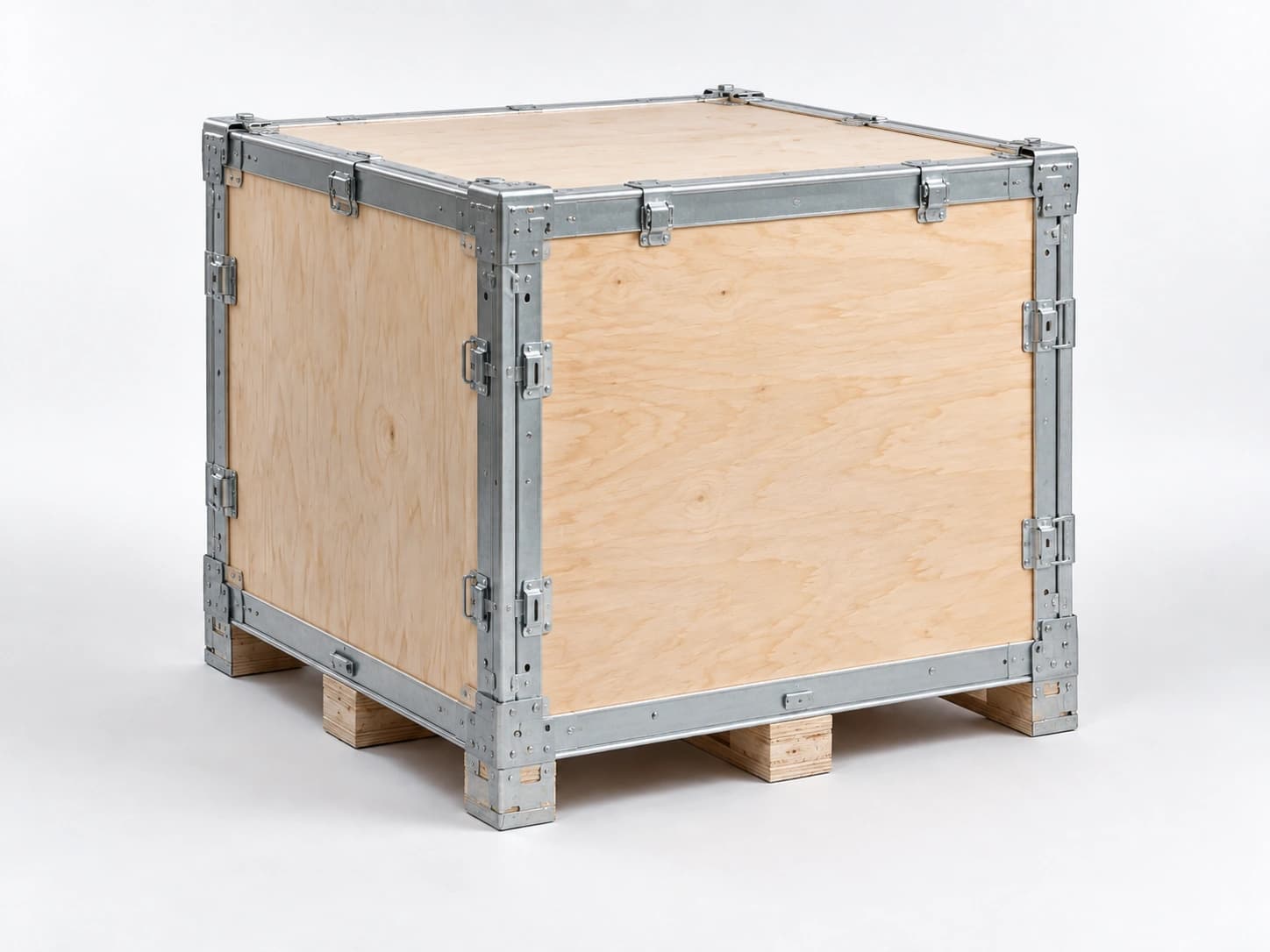
When a crate is reused dozens of times, nails become the weak point: every teardown damages the panels and strength drops with each cycle. Steel strip boxes replace nails with continuously machine-crimped galvanised tongue steel edges. The nail-less interlock can be opened and closed repeatedly without perforating the panels, which extends service life.
Engineered From the Inside Out
Material
Selected multi-layer plywood panels (6mm to 12mm engineering grade)
Frame
Continuous machine-crimped cold-rolled galvanized tongue steel edges
Connection
Nail-less tongue interlocking system, fast disassembly & circular reuse
Application
Automotive modules, EV battery cabinets, high-frequency logistics
Technical Specification
| Size range | FAST ASSEMBLY |
|---|---|
| 01 Material | Selected multi-layer plywood panels (6mm to 12mm engineering grade) |
| 02 Frame | Continuous machine-crimped cold-rolled galvanized tongue steel edges |
| 03 Connection | Nail-less tongue interlocking system, fast disassembly & circular reuse |
| 04 Application | Automotive modules, EV battery cabinets, high-frequency logistics |
| Key features | MODULAR FAST-LOCK · COLLAPSIBLE · REUSABLE |
Figures above are standard reference configurations. Dimensions, panel grading and steel strip specification depend on cargo weight and reuse frequency, and can be customised to drawings.
Typical Industries
Frequently Asked Questions
How does a steel strip box differ from a conventionally nailed crate?
The difference is in how the panels are joined. Conventional crates are nailed, so disassembly damages both the panel and the nail holes, limiting reuse. Steel strip boxes use cold-rolled galvanised tongue steel edges crimped by a dedicated machine to form an interlocking closure, so repeated assembly leaves the panels intact — suited to multi-trip logistics. The nail-less construction also reduces injury risk during unpacking.
Can steel strip boxes be shipped flat to reduce freight cost?
Yes — this is one of the format's main advantages. Modular panels can be dismantled and stacked, occupying far less volume than an assembled crate, which materially lowers freight cost on return legs or empty repositioning, and allows assembly on site by a small team.
What cargo is it suited to?
Primarily industrial goods with a stable specification that circulate repeatedly: automotive modules, EV battery cabinets, switchgear and electrical assemblies, and high-frequency line-side containers. For one-off exports of highly irregular equipment, heavy-duty or fumigation-free crates are usually a better fit.
What panel thicknesses are available?
Multi-layer plywood is standard, graded from 6 mm to 12 mm. The choice is driven by cargo weight, crate dimensions and stacking requirements. Where capacity demands it, additional structural ribs or a tighter steel strip layout can be specified.
Send the Equipment Specs — Solution First, Then Price
Drawing review and on-site surveying available. The plant sits in Nansha, Guangzhou — about 30 minutes by road from the Nansha deep-water container terminal, so packed goods can be dispatched straight to port.