
Shockproof Damped Crate
防震木箱
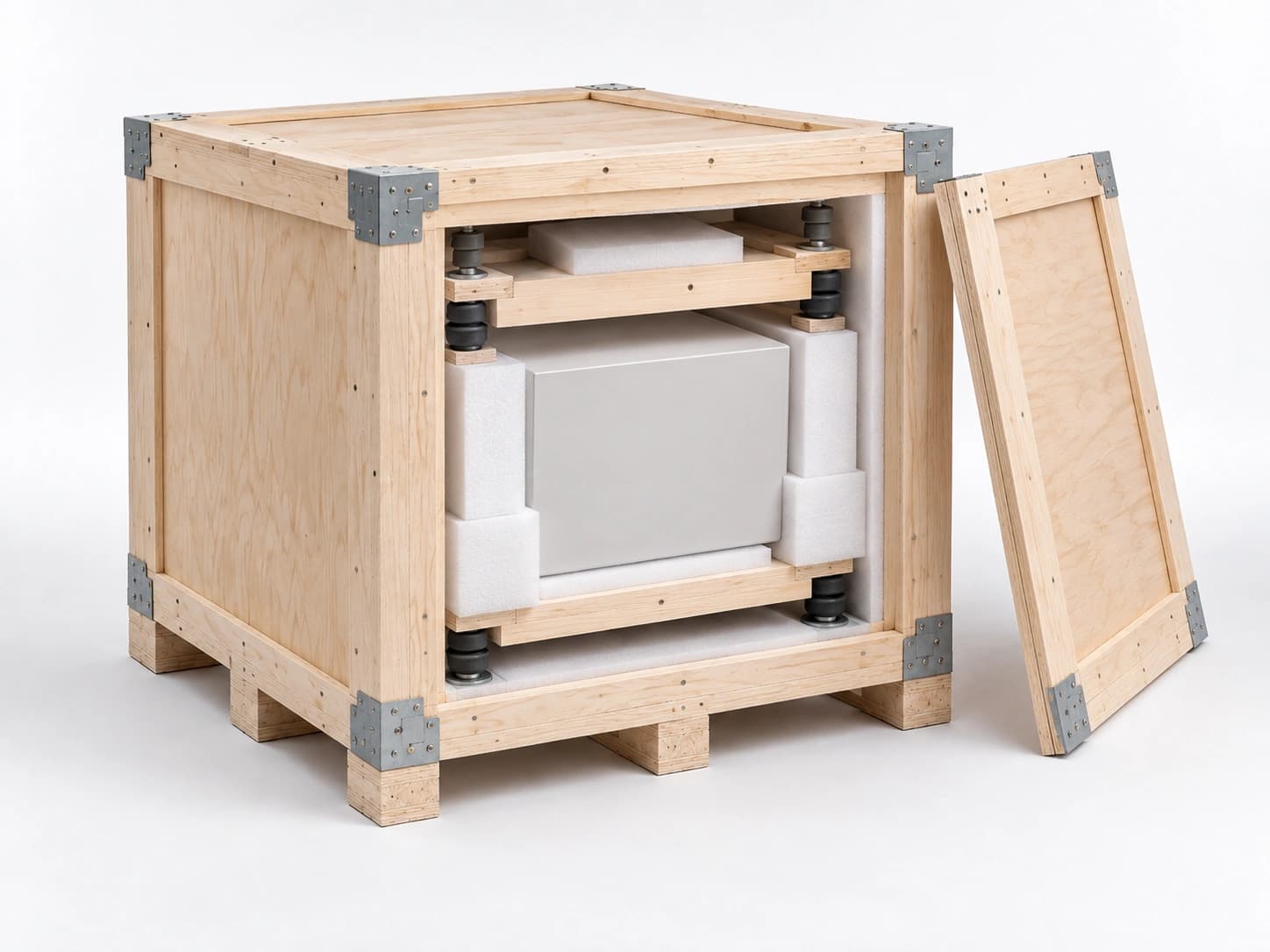
Precision equipment is more often damaged by shock than by compression: the instantaneous accelerations from sea-state motion, lifting and set-down, and road irregularities pose a greater risk than static load. A shockproof crate introduces a controlled elastic isolation layer between the outer body and the equipment, so impact energy is absorbed in stages rather than transmitted straight into the machine.
Engineered From the Inside Out
Material
Floating shock-isolation inner chassis with 6-sided energy-absorbing foam
Frame
Industrial damping spring coils and heavy-duty elastomeric rubber mounts
Connection
Dual nested floating enclosure integrated with impact & drop indicators
Application
Semiconductor equipment, precision optical instruments, aerospace modules
Technical Specification
| Size range | DAMPING SYSTEM |
|---|---|
| 01 Material | Floating shock-isolation inner chassis with 6-sided energy-absorbing foam |
| 02 Frame | Industrial damping spring coils and heavy-duty elastomeric rubber mounts |
| 03 Connection | Dual nested floating enclosure integrated with impact & drop indicators |
| 04 Application | Semiconductor equipment, precision optical instruments, aerospace modules |
| Key features | PRECISION INSTRUMENT · SUSPENSION DAMPING · G-FORCE SHIELD |
Figures above are standard reference configurations. The isolation design must be engineered against the equipment's allowable acceleration, fragility factor, mass distribution and transport profile. Technical parameters should be provided for individual confirmation.
Typical Industries
Frequently Asked Questions
What fundamentally separates a shockproof crate from a standard one?
The presence of a controlled isolation layer. Standard crates restrain movement through body stiffness and internal blocking — the equipment is held rigid. A shockproof crate places damping elements between inner and outer bodies, permitting controlled displacement within a designed range, so impact energy is converted into elastic deformation and damping losses, lowering the peak acceleration reaching the equipment.
Which damping elements are used?
A combination of industrial damping springs and heavy-duty polyurethane elastomer mounts provides multi-axis isolation. Inside, a composite floating chassis carries six-sided energy-absorbing foam. Inner and outer bodies are coupled through a floating connection, and impact and drop indicators can be fitted so that any exceedance during transit can be verified on arrival.
Which kinds of equipment is it intended for?
It targets high-value precision equipment sensitive to acceleration: semiconductor fabrication and inspection tools, precision optical instruments, medical and aerospace assemblies, and precision heat exchange or liquid-cooling modules. Equipment containing precision guideways, optical benches or pre-calibrated components generally calls for shock-isolated rather than rigidly blocked packaging.
How do you know whether an excessive shock occurred in transit?
Impact and drop indicators can be installed inside the packaging; these change colour or state irreversibly once acceleration exceeds a set threshold. The result can be read on arrival without specialist instruments, supporting liability determination and a pre-unpacking condition check. Thresholds are set according to the equipment's allowable acceleration.
Send the Equipment Specs — Solution First, Then Price
Drawing review and on-site surveying available. The plant sits in Nansha, Guangzhou — about 30 minutes by road from the Nansha deep-water container terminal, so packed goods can be dispatched straight to port.