
Cable Drums & Reels
各类型电缆线盘
A cable drum is typically consumed on a single trip, yet its quality determines whether the cable arrives intact. Under-strength flanges deform under winding tension, an imprecise spindle bore causes run-out during pay-off, and unreliable tie rods can loosen over a long sea voyage. These three points account for most drum failures.
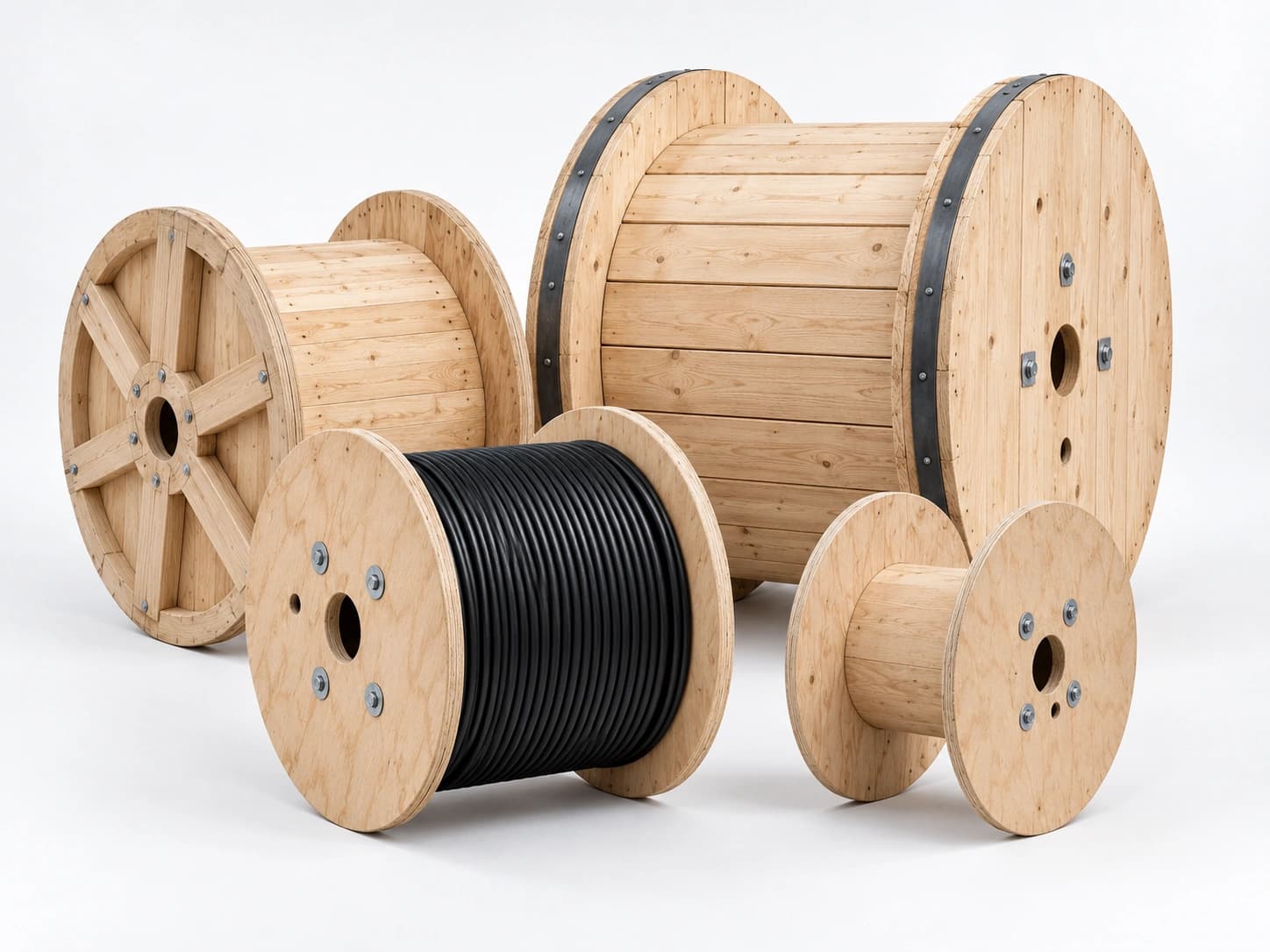
Engineered From the Inside Out
Material
Selected Larch Timber / High-Density Structural Plywood
Frame
Cross-laminated dual-flange plates with reinforced center spindle bore
Connection
Through-bolt high-tensile threaded tie rods with dual locknuts
Application
Optical fiber cables, high-voltage cables, and wire rope transit
Technical Specification
| Size range | Φ 600-2400mm |
|---|---|
| 01 Material | Selected Larch Timber / High-Density Structural Plywood |
| 02 Frame | Cross-laminated dual-flange plates with reinforced center spindle bore |
| 03 Connection | Through-bolt high-tensile threaded tie rods with dual locknuts |
| 04 Application | Optical fiber cables, high-voltage cables, and wire rope transit |
| Key features | COMMUNICATION · CABLE WINDING · SOLID WOOD & PLYWOOD |
Figures above are standard reference configurations. Drum specification depends on cable diameter, length per drum, winding tension and pay-off method. Sizes outside the Φ600–2400 mm range can be customised.
Typical Industries
Frequently Asked Questions
How should drum size be selected?
Three parameters dominate: cable outer diameter, length per drum and the permitted weight ceiling. The barrel diameter must respect the cable's minimum bend radius to avoid damaging optical fibres or insulation, while the flange diameter sets winding capacity. Standard coverage spans Φ600–2400 mm, with sizes outside that range made to drawing.
Wooden or steel-wood reel — how to choose?
It comes down to weight and transport severity. All-wood drums are lighter and lower cost, suiting general cable and fibre optic applications. Steel-wood construction adds steel reinforcement at the flange or plate, improving resistance to deformation and impact — better for large-section high-voltage cable, wire rope and multi-leg shipments.
What does the dual-flange plate structure do?
Cross-laminated dual plates distribute flange loads in multiple directions, raising bending stiffness appreciably compared with a single layer and reducing deformation under winding tension and stacking. Combined with a reinforced central spindle bore, this keeps rotation stable and run-out low during winding and pay-off.
Can drums be recovered or reused?
Wooden drums are generally treated as one-trip export packaging and are recycled after pay-off. Some specifications can be reconditioned for short-haul reuse provided the structure and plates are undamaged, but reuse after ocean transit is not recommended, since the material has already accumulated fatigue from the voyage.
Send the Equipment Specs — Solution First, Then Price
Drawing review and on-site surveying available. The plant sits in Nansha, Guangzhou — about 30 minutes by road from the Nansha deep-water container terminal, so packed goods can be dispatched straight to port.